Tag: self improvement

  • Embracing the Unknown: My Number One Takeaway from Solo Travel

    Embracing the Unknown: My Number One Takeaway from Solo Travel

    “The world is a book, and those who do not travel read only one page.” – Saint Augustine

    Travelling a few times now, my journey has evolved from travelling in groups to either one other person or solo. With everyone having different schedules, it’s not easy to organise, so the best thing is to not let anyone hold you back. I previously wrote a blog on why we should travel solo, but in this post, I’d like to dive deeper. I want to discuss the number one takeaway that I will forever carry with me, now engraved in me like a tattoo.

    The Brain: Our Constant Companion

    Before diving deeper, it’s important to understand that the brain is a powerful part of the body, and it plays mind games with us regularly. The funny thing about being human and having this ticking bomb between our ears is that it’s working non-stop, forever wired, whether you’re sleeping or in a coma. Science even proves that the brain functions for 10 minutes after death! This is why it’s crucial to understand how it functions and to use it to our advantage.

    Our brains are constantly processing information, making sense of the world around us, and guiding our decisions. When we travel solo, we are exposed to new environments, cultures, and experiences that challenge our usual way of thinking. This forces our brains to adapt, learn, and grow. The more we step out of our comfort zones, the more we expand our mental horizons, enhancing our cognitive flexibility and emotional resilience.

    Growing Up in a Melting Pot

    I grew up in one of the most well-known cities in the world, London. Although London is a diverse city with several different cultures and religions, the area I specifically grew up in, where my mum still lives, happens to be less diverse, with the majority being Asians and a few black people. Believe me when I tell you that we would rarely see a white person. There was a time in secondary school when we played a game of “who would point out the next white person”! My friends and I probably ventured no more than a 5-mile radius from the house I lived in.

    Growing up in this environment shaped my worldview in ways I didn’t fully realise until I started travelling solo. I was surrounded by people who shared similar cultural backgrounds, beliefs, and values, which created a sense of familiarity and comfort. However, it also meant that my exposure to different perspectives was limited. Travelling solo changed that dramatically.
    Limited by Beliefs

    Despite London’s diversity, I grew up close-minded with certain beliefs. These beliefs were passed down from my parents, who were born and raised in North Africa, Sudan. Growing up in an Islamic family, I was taught to always respect my elders, fast for a whole month once a year, pray five times a day, come home before it gets dark, and the list goes on. These beliefs influenced me to hang around with people with the same mindset.

    But this could’ve also gone the other way. I could’ve made friends with people who had completely different personalities from my family. The way we grow limits us. This is part of psychology, known as confirmation bias. We see the world and everything around us the way we want to see it. We tend to hang around with people who have similar beliefs to ours. It’s difficult to be friends with people who have a completely different opinion of the world. Think of your top three friends and see if what I’m saying is right or wrong.

    Confirmation Bias and Media Consumption

    I have a certain political belief, which means I tend to only watch news that aligns with my beliefs. If I were to watch something that contradicts my beliefs, it would completely rock my foundation. I read books that intrigue me and follow those on social media who think like me, reinforcing my beliefs. This isn’t inherently negative or positive; it’s just the way it is. But I’m learning to question whether my beliefs are truly mine or if they are a product of nature and nurture. Is it this way because of how I was raised?

    Confirmation bias doesn’t just affect our political views; it influences nearly every aspect of our lives. When we travel solo, we are more likely to encounter people, cultures, and situations that challenge our preconceived notions. This exposure helps us recognise our biases and question our assumptions. By actively seeking out diverse perspectives, we can break free from the echo chambers that limit our growth.

    Social Media: An Echo Chamber

    Social media platforms like Facebook, Instagram, TikTok, Snapchat, YouTube, and X (aka Twitter) have algorithms, computers built by people. These platforms create an echo chamber where we only hear our beliefs. For example, Facebook makes money when you’re on Facebook through ads. They provide the information you want because they know what you like and what you clicked on, so they provide similar content.

    This echo chamber effect can be detrimental to our personal growth and understanding of the world. When we travel solo, we step outside of our digital echo chambers and immerse ourselves in the real world. We meet people with different backgrounds, beliefs, and experiences, which can help us gain a more balanced and nuanced perspective. By disconnecting from our online bubbles, we open ourselves up to genuine human connections and transformative experiences.

    Challenging Our Beliefs

    If someone brings up a significant issue that I believe in and it makes me angry, it triggers something within me, showing where I’m stuck. What happens if one of our beliefs goes against what we believe in? Then we look for ways to avoid the negative and see the positive. A popular example is the iPhone vs. Samsung or the PlayStation vs. Xbox debate. We have to prove that our choice is the right one, even if we know we’re wrong! It’s a fragile ego at play. We don’t like being wrong, so we rationalise our choices, especially when they are bad.

    Solo travel forces us to confront these challenges head-on. When we are on our own, there is no one else to validate our choices or reinforce our beliefs. We have to rely on our instincts, make decisions independently, and navigate unfamiliar situations. This process helps us develop critical thinking skills, resilience, and self-awareness. By embracing the discomfort of challenging our beliefs, we grow stronger and more adaptable.
    The Importance of Openness

    Nothing will shake a person more than proving they are wrong. No one wants to be stuck in their ways, unwilling to hear other people’s sides and stories. If we don’t open up to hear other people’s thoughts and opinions, we eventually become old and cynical. I know family members who have been stuck in their ways for a long time, becoming more rigid the longer they live that way.

    Travelling solo has taught me the number one lesson: embracing the unknown. When you’re out there on your own, you have to rely on yourself, make decisions, and face challenges without a safety net. This has forced me to step out of my comfort zone, confront my fears, and grow as a person. I’ve learned to adapt to new situations, interact with diverse people, and appreciate different cultures. This experience has broadened my perspective, helping me to question my beliefs and be more open to new ideas.

    Embracing the Unknown

    The most significant lesson I’ve learned from solo travel is the importance of embracing the unknown. When we travel alone, we are often faced with uncertainty and unpredictability. Whether it’s navigating a new place, trying new foods, or making friends with strangers, solo travel pushes us to embrace new experiences with an open mind.

    This openness to the unknown helps us become more adaptable and resilient, better equipped to handle life’s challenges. It encourages us to step out of our comfort zones and try new things, leading to personal growth and self-discovery. Most importantly, it teaches us to embrace change and uncertainty.

    Building Self-Confidence

    Travelling solo also builds self-confidence. When you navigate a new place on your own, you learn to trust your instincts and make decisions independently. This newfound confidence extends beyond travel and into other areas of your life. You become more self-assured and capable, ready to take on new challenges and pursue your goals with determination.

    Connecting with Yourself

    One of the most rewarding aspects of solo travel is the opportunity to connect with yourself. Without the distractions of familiar surroundings and company, you have the space and time to reflect on your thoughts, feelings, and aspirations. This self-reflection can lead to greater self-awareness and a deeper understanding of your values and priorities.

    Forming Meaningful Connections

    While solo travel is often seen as a solitary experience, it can also lead to meaningful connections with others. When you travel alone, you are more approachable and open to meeting new people. Whether it’s fellow travellers, locals, or strangers you meet along the way, these interactions can enrich your travel experience and create lasting memories. Staying in Hostels with Hostel World and using Tiqets to join tours has helped me a lot to meet other people.

    Conclusion

    Travelling solo is more than just an adventure; it’s a journey of self-discovery and growth. It pushes us out of our comfort zones, challenges our beliefs, and helps us understand the world from different perspectives. By travelling solo, I’ve learned to embrace the unknown, question my beliefs, and open myself to new experiences. So, if you’re contemplating a solo trip, remember that it’s not just about the destinations you visit but also about the person you become along the way.


  • Unlock the Power Within: 6 Ways to Connect with Your Subconscious Mind

    Unlock the Power Within: 6 Ways to Connect with Your Subconscious Mind

    The subconscious mind is a powerful tool that controls access to your strongest and weakest emotions. When mixed with feelings, it can either break a person or push them away from their true desires, leading to a life quite opposite of what they truly want. However, you can control this part of your brain by focusing on your strongest emotions.

    We all know that a thought can consume you, especially when repeated over and over again. Last year, I experienced terrible thoughts that put me in a spiral, making me feel like there was no escape. Slowly, I improved by placing positive thoughts in my mind. The good will always outweigh the bad, and the same applies to the emotions you carry. Negative thoughts are a heavy load that even you won’t be able to lift if not released.

    Disclosure: This post contains affiliate links. If you use these links to buy the book, I may earn a commission at no extra cost to you. I only recommend products that I believe will add value to my readers.

    The Subconscious Mind Works Day and Night

    The subconscious mind draws upon your inner strength to create something physical, whether it’s money, love, family, or the confidence to travel solo. While you may not have 100% control over your subconscious mind, the idea is to feed it with your plans, goals, and purposes to create something concrete, something you can see with your own eyes.

    The Power of the Subconscious Mind by Joseph Murphy

    We all know the feeling of working hard but still not getting what we want, or feeling the opposite and achieving success with little effort. The answer lies in the subconscious mind. Below, I’ve listed six key points in detail taken from the book.

    1.      The Difference Between the Conscious and Subconscious Mind

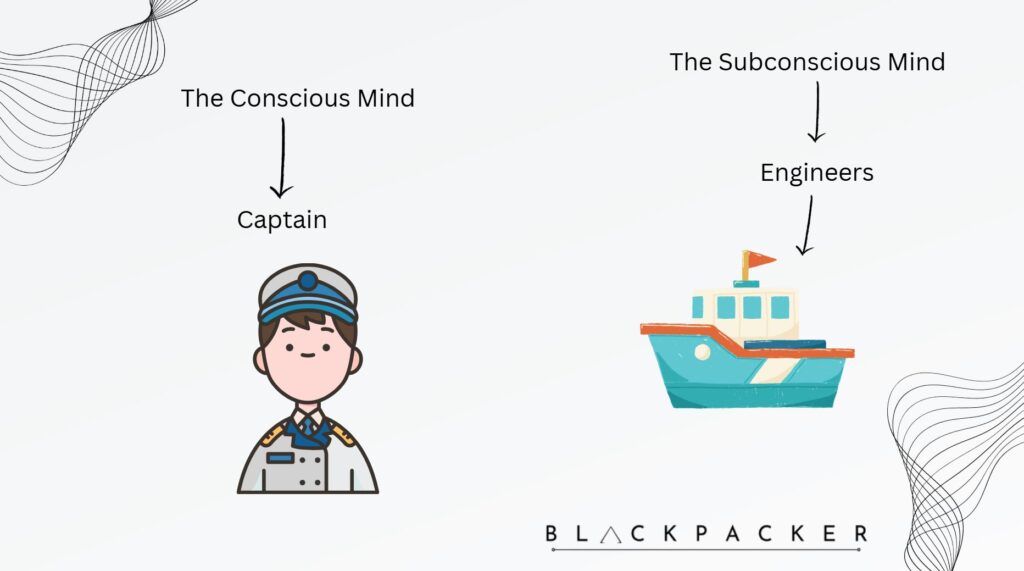
    The conscious mind is like the captain of a ship, staying on the deck and seeing where it’s going. On the other hand, the engineers, who control the engines and other instruments, follow the captain’s orders without knowing the destination. The engineers represent the subconscious mind.

    Think of your conscious mind as the captain of your ship (your body and environment). Your subconscious mind takes orders based on what your conscious mind believes and accepts as true, without questioning them. The subconscious mind is like soil; whatever seed you plant, it will grow. It does not have the ability to argue or dispute, so if you provide it with incorrect information, it will accept it as true. For example, if you keep saying, “I can’t afford it,” you will go through life believing that because you created that thought.

    2.      You Have a Fundamental Right to Be Rich

    Don’t let anyone make you feel ashamed of your desire to become rich. Just as freely circulating blood indicates physical health, freely circulating money indicates economic health. If you were physically ill, you would seek ways to improve your health, whether by going to the pharmacy for medication or consulting a doctor for advice. Have you ever wondered why you can’t get what you want? These emotions are often the reasons why.

    Reason No. 1 – Envy

    Whenever I used to see someone in my neighborhood driving a fancy car, my friends and I would wonder how they afforded it. We speculated that they might have sold drugs or engaged in other illegal activities. We talked enviously behind their back. After understanding the book, I chose to change my behavior because I realized envious thoughts put me in a negative position. You lose what you condemn and cannot attract what you criticize or envy. I wouldn’t be with a partner who always criticizes me, and neither should you. Find motivation in someone driving a nice car and tell yourself that you can achieve it as well.

    Reason No. 2 – Trying Too Hard

    If I asked you to walk on a narrow plank on the ground, you would do it easily as there’s no risk of danger. But if I asked you to walk on a plank 50 meters high between two walls, you probably wouldn’t do it because you would imagine falling. Fear would stop you because there’s a good chance you might fall. Never try to force your subconscious mind to accept an idea using willpower; such attempts will lead to failure. The effortless way is better.

    Have you ever revised so hard for an exam, but when you sit down to take it, you suddenly forget everything? The harder you try, the more you forget, but you remember it later. The mistake is forcing yourself to remember. Instead, relax and imagine passing. If you do this, your subconscious mind will help you see new solutions and meet new people.

    Don’t fixate so much on the end goal that you forget to notice what’s around you. Your solution can come from the most unexpected source. Be open to new solutions. It’s not your job to know how you will reach the destination; your job is to know where you’re going, and your subconscious mind will know how to get there. For example, you wouldn’t go to a doctor with a solution; you would expect the doctor to give you the solution.

    Reason No. 3 – Fear

    I set affirmations and did visualizations, but I still got no results. That was because I probably indulged in fearful thoughts. You can’t keep asking the taxi driver to change directions while you’re already en route; it will just confuse things. It’s the same with working with your subconscious mind. It’s important to have a clear idea in your mind and believe there’s a way out with a solution to a problem. Before doing something you’re scared to do, sit down, relax your mind, and visualize yourself winning before attempting it.

    3.      How to Visualize Your Goals

    The easiest way to visualize your goals is to see them in your mind as if they were already alive. Can you see things that don’t yet exist? Of course, you can. The same way a phone or a laptop came into existence—someone saw it before it was made. This is what architects, engineers, and artists do. As a Civil Engineer, I would never build anything without having a design in place. So, it’s important to visualize something before you start building it.

    The best time to visualize your goals is before you go to sleep and after meditation. When you’re in a relaxed and sleepy state, the conflict between the conscious and subconscious mind is reduced, allowing the subconscious mind to work better on your goals. We spend one-third of our lives sleeping, and many answers to our problems come to us during sleep.

    4.      How to Receive Guidance from Your Subconscious

    When you have to make a difficult decision or fail to see a solution, you need to think constructively. If you are fearful or worried, then you’re not thinking properly. True thinking is free from fear. Here are some simple techniques to receive guidance on any subject:

    • Quiet the mind and still the body (get it to relax).
    • Focus your thoughts on the solution to your problem.
    • Try to solve it with your conscious mind.
    • Think about how happy you would be with the perfect solution.
    • Let your mind play with this mood of happiness in a relaxed way.

    After you do this, drop off to sleep. If you wake up without the answer, just keep working and don’t pressure yourself to get the answer. Feel the joy of the answer.

    The book shows several good examples of how people used this technique to find answers and solutions to their problems, including the author himself. For instance, he found a ring he had lost by asking a neighbor’s kid if he had seen it, and to his surprise, the kid had put it on a table in his house.

    5.      How to Use Your Subconscious Mind for Forgiveness

    Life always forgives you. It forgives you for cutting your finger or dislocating your hand by repairing it over time. But we struggle to do the same; we feel terrible every time we think about those moments where we could have done better.

    We all have a few things from our past that we regret, whether it’s something we said to our parents, something we did to our friends, or how we managed our money. Years may pass, but you might still feel terrible about those moments. If this applies to you, consider this: scientists say that every cell in our body is replaced every 11 months, both physically and psychologically. Do you know what that means? It means that you are reborn every 11 months.

    If you are still sacrificing your peace over something you did 11 months ago, then you are blaming an innocent person. It’s easier said than done, but look to forgive yourself.

    6.      How to Use Your Subconscious Mind for Healing

    If you created a watch and one day it stopped working, you would know how to fix it, right? The subconscious mind is like a watchmaker; it created your body and knows exactly how to heal it without the help of your conscious mind. Your conscious mind cannot operate your body, but it can interfere with its proper functioning. For example, if you put a random person in the cockpit of a plane, they wouldn’t know how to operate it, but they could distract the pilot.

    Products of the conscious mind, such as worry, anxiety, fear, and depression, interfere with the normal functioning of the heart, lungs, and stomach, causing problems. Stress disrupts the harmonious functioning of your subconscious mind. When you feel mentally and physically drained, the best way is to let go or at least slow down the wheel of your thought process. Only allow positive thoughts in your mind, such as harmony, health, and peace, and all the functions of your body will improve.

    My Last Takeaway

    The feeling of health produces health. The feeling of wealth produces wealth.

    If you found the points mentioned in this article helpful, I highly recommend reading The Power of Your Subconscious Mind by Joseph Murphy. This book delves deeper into the concepts discussed and provides practical techniques to harness the power of your subconscious mind. Click here to purchase the book on Amazon and start your journey towards a more empowered and fulfilling life.